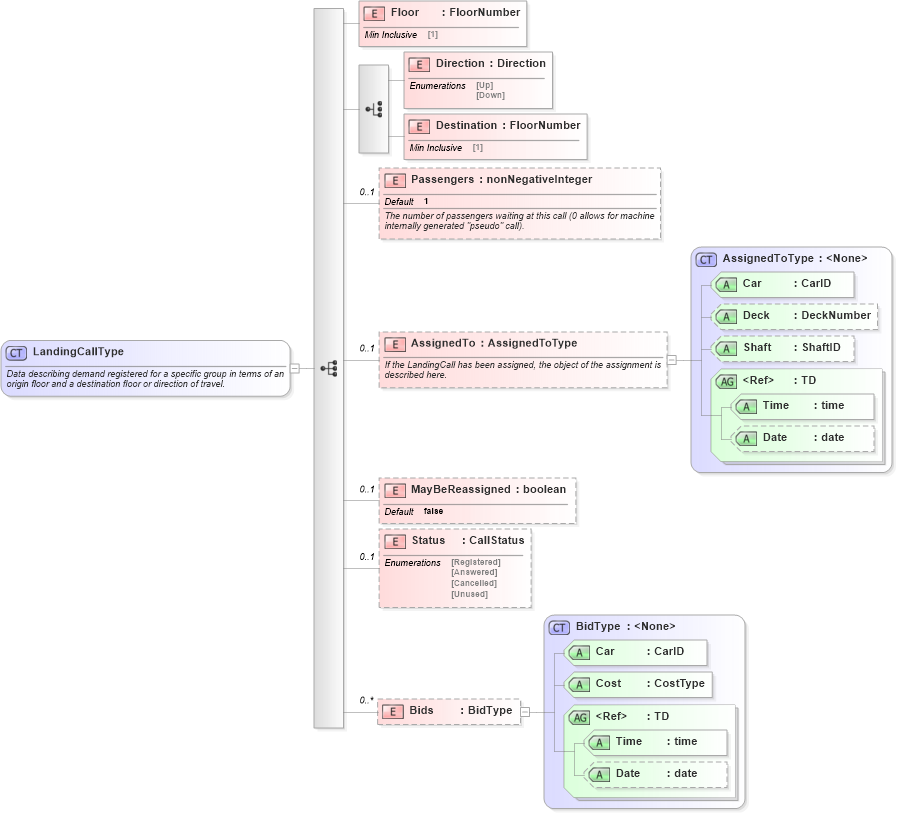
<xs:complexType name="LandingCallType">
    <xs:annotation>
        <xs:documentation>Data describing demand registered for a specific group in terms of an origin floor and a destination floor or direction of travel.</xs:documentation>
    </xs:annotation>
    <xs:sequence>
        <xs:element name="Floor" type="FloorNumber" />
        <xs:choice>
            <xs:element name="Direction" type="Direction" />
            <xs:element name="Destination" type="FloorNumber" />
        </xs:choice>
        <xs:element name="Entrance" type="DoorID" minOccurs="0">
            <xs:annotation>
                <xs:documentation>Optionally specify the entrance door, which is associated with the landing call, that the passenger would have to use.</xs:documentation>
            </xs:annotation>
        </xs:element>
        <xs:element name="Passengers" type="xs:nonNegativeInteger" minOccurs="0" maxOccurs="1" default="1">
            <xs:annotation>
                <xs:documentation>The number of passengers waiting at this call (0 allows for machine internally generated "pseudo" call).</xs:documentation>
            </xs:annotation>
        </xs:element>
        <xs:element name="AssignedTo" type="AssignedToType" minOccurs="0">
            <xs:annotation>
                <xs:documentation>If the LandingCall has been assigned, the object of the assignment is described here.</xs:documentation>
            </xs:annotation>
        </xs:element>
        <xs:element name="MayBeReassigned" type="xs:boolean" minOccurs="0" maxOccurs="1" default="false">
            <xs:annotation>
                <xs:documentation>This call may be re-assigned to another car. Reassignment might be restricted to another car in the same shaft if the AssignedTo.ShaftID attribute is set (e.g. where the passenger has been directed to use a specified entrance). Can be set false by the car if it is already too late NOT to stop.</xs:documentation>
            </xs:annotation>
        </xs:element>
        <xs:element name="Status" type="CallStatus" minOccurs="0" />
        <xs:element name="Bids" type="BidType" minOccurs="0" maxOccurs="unbounded" />
    </xs:sequence>
</xs:complexType>
|
 XSD Schema Diagram: